

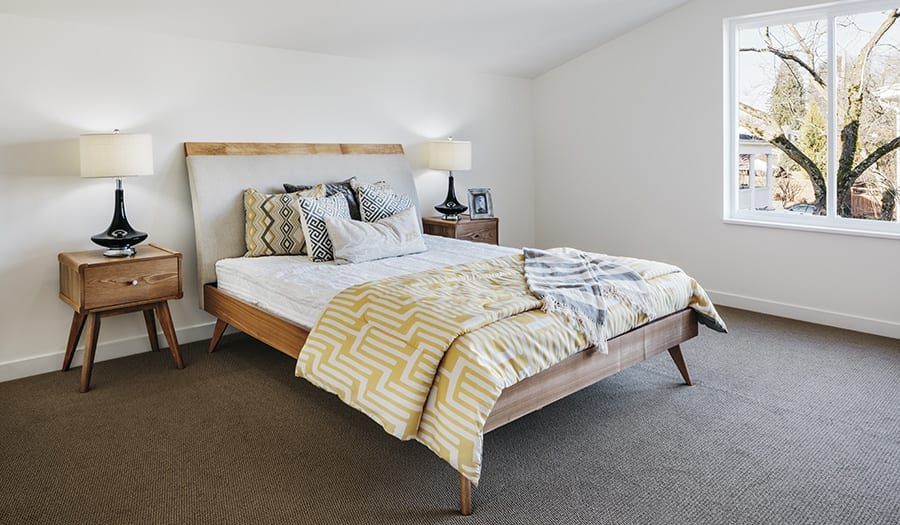
For more than two decades, residential interior design operated under an almost universal doctrine: rip out wall-to-wall carpeting and lay hard surfaces everywhere. Driven by the sleek appeal of wide-plank European white oak, the durability of engineered timber, and the budget-friendly practicality of luxury vinyl plank, homeowners purged soft flooring from their floor plans. Real estate listings proudly advertised “hardwood throughout,” framing any remaining carpet as a dated remnant of the late twentieth century that was destined for the dumpster.
In kitchens, hallways, and open-concept living rooms, that hard-surface revolution made total sense. Those areas endure dropped pots, spilled drinks, heavy foot traffic, and muddy paws, all of which demand surfaces that can be wiped down in seconds.
Yet as the hard-surface wave swept unchecked into bedrooms, homeowners began noticing an unexpected side effect. The spaces meant to serve as quiet, restful sanctuaries often felt stark, chilly, and hollow. The early-morning shock of cold wood under bare feet, the clatter of pet claws at two in the morning, and the echo of voices bouncing between drywall and floorboards left many longing for something softer.
Today, a quiet shift is taking place in residential architecture. Carpet is staging a measured, design-forward comeback in the bedroom, shedding its outdated reputation and reemerging as a deliberate choice for comfort, acoustic tranquility, and sensory warmth.
The Hard Surface Backlash and the Search for Bedroom Warmth
The current resurgence of bedroom carpeting is largely a reaction to the limitations of living with hard surfaces in intimate spaces. While a continuous sweep of hardwood across an entire floor looks cohesive in architectural photography, everyday life inside that space tells a different story.
Bedrooms serve a completely different psychological function than the rest of the house. They are environments reserved for winding down, restorative sleep, and sensory relief from the demands of the day. Hard surfaces, by their very nature, are rigid, reflective, and cool to the touch.
To counteract this sterile feel, homeowners who installed hardwood or vinyl plank inevitably found themselves shopping for oversized area rugs. This created what many designers call the area rug paradox. Homeowners spend thousands of dollars to install high-end wood flooring in a primary suite, only to purchase an eight-by-ten or nine-by-twelve rug to cover nearly eighty percent of the room.
The resulting layout often creates awkward compromises: an eighteen-inch perimeter of bare wood around the walls, edges that curl or bunch under sliding nightstands, and a constant tripping hazard along the borders. Furthermore, an area rug leaves hard walking paths along the sides of the bed, defeating the desire for soft, warm landings during late-night or early-morning steps.
Returning to wall-to-wall carpeting in the bedroom eliminates these awkward borders, providing a unified, tailored foundation that embraces the entire footprint of the room.
How Modern Carpet Evolved Past 1990s Nostalgia
Much of the lingering resistance to carpet stems from memories of the builder-grade materials installed during the housing booms of the 1980s and 1990s. Those floors were defined by loose, uniform cut-pile polyester—often in uninspiring shades of beige or oatmeal—that quickly crushed into flat, matted paths along heavy traffic lanes. They held onto stains, trapped odors, and off-gassed strong chemical scents from cheap petroleum backings.
Modern carpet bears little resemblance to those obsolete styles. The industry has undergone a design evolution, shifting away from generic shag and low-density cut-piles toward sophisticated textures and architectural weaves.
Today’s popular profiles focus on tactile structure and visual depth:
-
Tailored loop and ribbed bouclé: Tightly woven low-profile loops deliver a tailored, European appearance reminiscent of high-end wool menswear or textured linen.
-
Cut-and-loop geometric patterns: Subtle variations in pile height create geometric grids, delicate diamonds, or abstract striations that catch light without looking busy.
-
Warm, grounded color palettes: The monotonous cream-and-tan options of the past have given way to organic neutrals, soft clay, slate blue, sage green, and warm charcoal tones that anchor contemporary furniture.
Rather than trying to look invisible, modern carpet functions as an intentional architectural textile. It brings tactile dimension into rooms dominated by clean drywall lines, metal window sashes, and flat-panel cabinetry.
The Acoustics of Sleep: Why Quiet Rooms Demand Soft Flooring
Sleep hygiene discussions routinely focus on ambient room temperature, mattress firmness, and the elimination of blue light from screens. Yet acoustic resonance is just as critical to achieving deep, uninterrupted rest, and it is here that hard flooring presents its most glaring weakness.
Hard materials like wood, tile, and laminate are acoustically reflective. They bounce sound waves back into the room with minimal dampening, creating what acoustic engineers call slapback echo and high-frequency flutter. Every ambient sound—the hum of an HVAC register, a passing siren outside, a partner shifting under heavy blankets, or a television playing two rooms away—reverberates off the floor and lingers in the air.
Carpet operates as a massive sound absorber. Standard commercial and residential testing demonstrates that wall-to-wall carpet absorbs between thirty and fifty percent of airborne noise, compared to less than five percent absorbed by hard surfaces.
Beyond taming airborne noise, carpet solves the issue of impact sound transmission. The sound of someone walking in heavy slippers, a dog pacing across the floor, or a dropped phone transmits through hard surfaces as a sharp, percussive vibration that travels through subfloors and into adjacent rooms. Carpet cushions that impact at the point of contact, reducing floor vibration to near silence. For upper-level bedrooms situated directly above ground-floor living rooms or home offices, this dampening effect transforms the peacefulness of the entire house.
Rethinking the Allergen Debate: Airborne Dust Versus Surface Trapping
For decades, the standard medical advice given to allergy and asthma sufferers was simple: remove all carpeting immediately. The conventional assumption held that hard floors are naturally cleaner because dust, pet dander, and pollen have nowhere to hide.
Recent evaluations of indoor air dynamics have added significant nuance to this long-standing assumption.
On a hard wood or vinyl floor, settled particulates have no mechanical anchor. The moment an occupant walks into the room, a ceiling fan turns on, or the central furnace kicks on, settled dust and dander are swept back into the air. The hard surface acts as a launchpad, keeping fine particulates circulating continuously within the home’s breathing zone throughout the day and night.
Wall-to-wall carpet acts as a passive air filter. The pile traps dust, dander, and seasonal allergens deep within the matrix of its fibers, holding them securely out of the ambient airflow until they are physically removed.
The determining factor in indoor air quality is not the presence of carpet, but the method of cleaning. When paired with a modern vacuum cleaner equipped with a sealed HEPA filtration system, carpet holds contaminants in place and allows them to be removed without exhausting microscopic dust back into the bedroom air. Additionally, modern manufacturing standards have drastically reduced emissions, with third-party testing programs ensuring that compliant carpets, cushions, and adhesives emit negligible volatile organic compounds (VOCs).
Material Innovations: Natural Wool Versus High-Performance Synthetics
The decision to install bedroom carpet today typically leads homeowners down one of two paths: timeless natural fibers or cutting-edge synthetic polymers. Each offers distinct advantages depending on household priorities.
The Enduring Appeal of Wool
For homeowners prioritizing sustainability, natural materials, and longevity, 100% natural wool remains the gold standard of flooring. Wool is an inherently renewable, biodegradable fiber with an extraordinary natural architecture.
Because wool fibers possess a three-dimensional natural crimp, they behave like tiny coiled springs. When compressed beneath heavy bed frames, dressers, or prolonged foot traffic, wool naturally rebounds rather than crushing permanently flat.
Wool also excels at indoor humidity regulation. Its porous cellular core can absorb moisture vapor from humid air during summer and release it back into dry air during winter without ever feeling damp to the touch. Furthermore, wool fibers are coated in a natural microscopic membrane that repels water-based spills and resists dirt penetration, allowing for straightforward maintenance without the need for topical chemical treatments.
Advanced Solution-Dyed Synthetics
For households with young children, active pets, or tighter budgets, advanced synthetic fibers offer unmatched resilience against deep staining and abrasive wear.
The most notable advancement in synthetic flooring is the widespread adoption of solution-dyed nylon and triexta fibers. In traditional manufacturing, white synthetic yarns were spun first and dyed afterward, leaving the core of the fiber vulnerable to liquid absorption if a stain penetrated the surface coating.
With solution dyeing, color pigments are mixed directly into the molten polymer liquid before the fibers are even extruded. The color exists uniformly throughout the entire cross-section of the fiber, much like a carrot rather than a radish.
Because there are no open dye sites within the molecular structure of the finished yarn, common bedroom staining culprits like coffee, red wine, cosmetic oils, or pet accidents cannot chemically bond with the fiber. Many of these modern polymers can be cleaned with mild household detergents or even diluted water-and-vinegar solutions without stripping color or damaging the structural integrity of the pile.
Practical Design Rules for Bringing Carpet Back into the Bedroom
Reintroducing carpet into a home dominated by hard surfaces requires thoughtful execution at the architectural transitions. A poorly planned installation can look like an accidental remnant rather than an intentional design choice.
Treat the doorway as a clean threshold. The transition between hard hallway flooring and plush bedroom carpet should sit directly beneath the door slab when the door is shut. Using low-profile, solid-metal transition bars in finishes that match your interior door hardware—such as brushed brass, oil-rubbed bronze, or matte black—ensures the joint looks crisp and intentional from either side.
Invest in the cushion beneath the carpet. Homeowners often allocate their entire flooring budget to the visible carpet surface while choosing the cheapest available padding. This is a critical mistake. The structural pad beneath the carpet accounts for half of the floor’s acoustic absorption, prevents fiber breakdown underfoot, and determines how comfortable the surface feels over time.
Opt for a dense, premium cushion, such as high-density memory foam or dense rubberized felt, rather than a loose, bouncy rebond pad. A dense pad supports the carpet backing, keeps heavy furniture legs from sinking too deep, and extends the aesthetic lifespan of the installation by years.
Plan for furniture placement. Modern textured loop piles can occasionally snag on rough or splintered furniture bottoms. Before setting heavy nightstands, wooden bed legs, or metal dressers onto new carpet, adhere smooth felt pads or wide furniture cups beneath all contact points. This simple prep step protects the weave and prevents localized crushing over decades of use.
The Right Floor for the Right Space
Interior design trends often swing between extreme opposites before settling into a sensible equilibrium. The complete banishment of carpet was an overcorrection—a well-intentioned push for clean lines and easy maintenance that neglected the emotional and physical requirements of restful private rooms.
Hard surfaces will continue to dominate high-traffic corridors, busy kitchens, and moisture-heavy bathrooms, where their practical benefits remain unmatched.
Yet inside the bedroom, where we spend a third of our lives resting, recovering, and seeking quiet, soft flooring fulfills a distinct human need. By combining tailored modern textures, superior acoustic dampening, and advanced fiber performance, wall-to-wall carpet has earned its place back in the modern home—not as a nostalgic compromise, but as the premier foundation for everyday comfort.